agentposture
AgentPosture
Find every AI agent in your organization and know how risky each one is.
AgentPosture connects to the places agents live (your code, your cloud AI platforms, your identity provider, your existing registries), builds one inventory, scores every agent against a transparent risk policy, and shows the result in a dashboard for leadership and a to-do list for each agent’s owner.
It is a single Python package with one dependency, a SQLite file for storage, and no build step. You can try it in one command and run it in production with one config file.
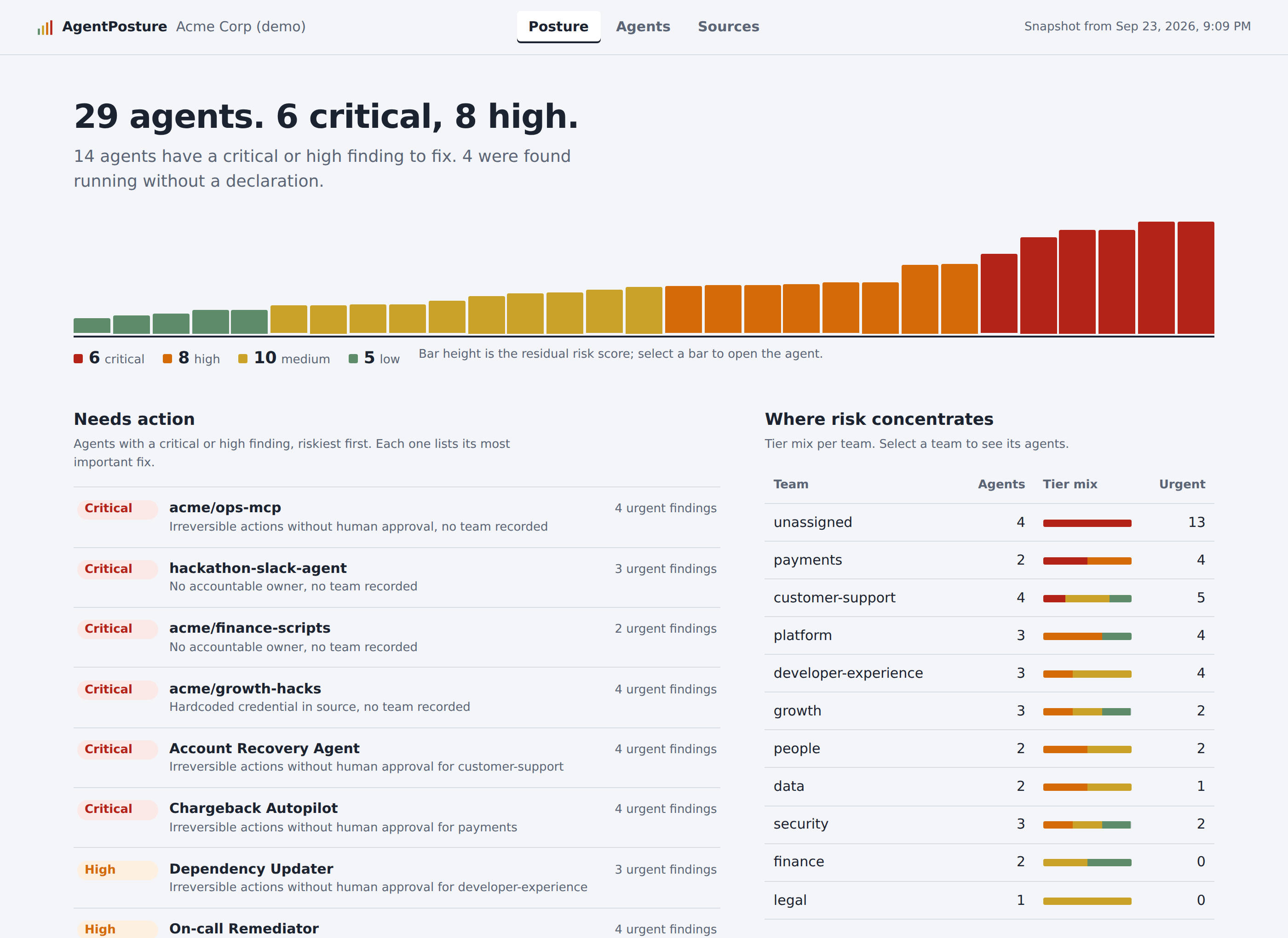
The sample dashboard in examples/sample-dashboard/ is one
self-contained HTML file: download index.html and open it, or enable GitHub Pages on this
repository to browse it online. The same folder has the Markdown report
and CSV export generated from the same data.
Try it in 60 seconds
pipx install git+https://github.com/xamitgupta/agentposture   # or: pip install agentposture
agentposture demo                                                     # opens a sample organization on http://localhost:8484
Or with Docker:
git clone https://github.com/xamitgupta/agentposture && cd agentposture
docker compose up                                                     # http://localhost:8484
The demo is a 29-agent company with the problems a real first scan finds: agents nobody declared, agents running with more permission than they claim, irreversible actions with no human approval, and a hardcoded API key.
Use it on your organization
agentposture init --org "Acme Corp"      # writes agentposture.yaml and an example agent.yaml
agentposture scan                        # discover, merge, score
agentposture serve                       # dashboard + API + scheduler on http://localhost:8484
The starter config scans the current directory for agent.yaml manifests and for agent code.
Uncomment the GitHub, AWS Bedrock, or Entra ID sections to add those sources. Every credential is
read-only and comes from an environment variable.
What it answers
| Who | Question | Where |
|---|---|---|
| CISO, risk committee | How many agents do we have, how many are critical, is it getting better? | Posture view, agentposture report |
| Security and GRC | Which agents are undeclared, unowned, or running with more than they declared? | Inventory health, Agents filters |
| Platform teams | Which fix removes the most risk across all agents? | Most common findings, Controls in place |
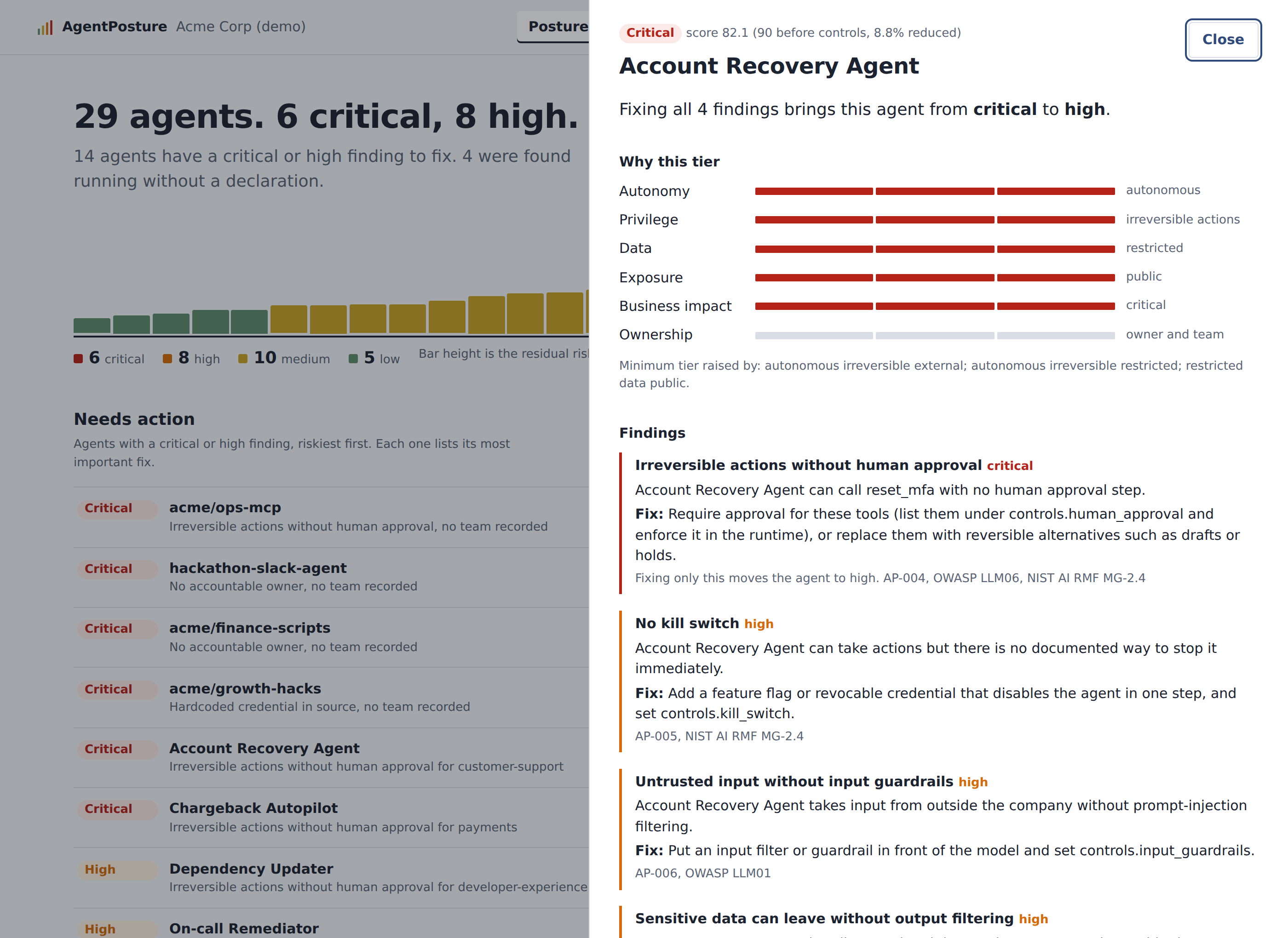
| Agent owners | Why is my agent High, and what exactly do I change to lower it? | Agent detail, agentposture show <id> |
| Engineers in CI | Will this agent.yaml pass the bar before it merges? | agentposture check, the GitHub Action |
How it works
flowchart LR
  subgraph Sources
    M[agent.yaml manifests]
    C[Code and MCP configs]
    G[GitHub org]
    A[AWS Bedrock]
    E[Entra ID]
    R[Existing registry / CSV]
  end
  Sources -->|evidence| MERGE[Merge on shared identity, repo, ARN]
  MERGE --> REG[(Registry: SQLite)]
  REG --> ENGINE[Risk engine: policy YAML]
  ENGINE --> REG
  REG --> UI[Dashboard and API]
  REG --> OUT[Reports, CI gate]
- Collect. Each connector yields evidence about agents it can see. Owners declare agents in
an
agent.yaml; discovery connectors observe what is actually running. - Merge. Evidence that shares a join key (an agent id, a service principal, a repository, a cloud ARN) becomes one agent. For every risk attribute the riskier of declared and observed wins, and any gap is recorded as drift. An observed agent with no declaration is a shadow agent.
- Score. Six dimensions (autonomy, privilege, data sensitivity, exposure, business impact, ownership) give an inherent score. Controls that are in place and relevant reduce it to a residual score, which sets the tier. Overrides raise the minimum tier for dangerous combinations, such as an autonomous agent with irreversible tools facing the public.
- Explain. Every finding carries a remediation, a framework mapping (NIST AI RMF, OWASP Top 10 for LLM Applications, CWE), and the tier the agent would reach if only that finding were fixed.
- Keep current. Each source runs on its own cron schedule, on a signed webhook, or on demand. Agents are reassessed the moment their attributes change, whenever the policy changes, and at least every N days by tier (critical daily, low quarterly by default).
Read docs/architecture.md for the full design.
Each agent’s owner gets the reasons behind the tier and a ranked list of fixes, with the tier each fix would reach:
Declaring an agent
Put this next to the agent’s code. Only id is required; everything you leave out is scored as
risky until someone fills it in.
id: refund-assistant
name: Refund Assistant
owner: priya@acme.example
team: payments
lifecycle: production
business_impact: high           # low | medium | high | critical
autonomy: act_with_approval     # read_only | recommend | act_with_approval | autonomous
exposure: customer              # internal | partner | customer | public
data: {sensitivity: confidential, types: [pii, financial]}
tools:
  - {name: lookup_order, action: read}
  - {name: issue_refund, action: irreversible, requires_approval: true}
controls: {kill_switch: true, audit_logging: true, input_guardrails: true, output_guardrails: true}
Full reference: docs/manifest.md. JSON Schema for editor completion: schemas/agent-manifest.schema.json.
Gate risky agents in pull requests
# .github/workflows/agent-risk-gate.yml
on: {pull_request: {paths: ["**/agent.yaml"]}}
jobs:
  check:
    runs-on: ubuntu-latest
    steps:
      - uses: actions/checkout@v4
      - uses: xamitgupta/agentposture@v1
        with: {fail-on: high}
Or anywhere else: agentposture check path/to/agents --fail-on high. It needs no server and no database.
Connectors
| Type | Finds | Needs |
|---|---|---|
manifest |
Declared agents in agent.yaml files |
Read access to the files |
code_scan |
Agent frameworks, tools, MCP servers, approval hints and hardcoded keys in local code | Read access to checkouts |
github |
Both of the above across a GitHub organization | Token with Contents: read |
aws_bedrock |
Bedrock agents, action groups, guardrails, IAM role permissions | Read-only IAM (listed in docs) |
entra_id |
Agent service principals, their API permissions, owners and credential type | Application.Read.All |
http_json |
Any JSON API or file: internal registries, Backstage, CMDB exports | Whatever the API needs |
csv |
A spreadsheet inventory | The file |
demo |
A sample organization | Nothing |
Adding a connector is one class with one method; see docs/writing-a-connector.md. Third-party connectors install as ordinary Python packages and are picked up automatically.
Command reference
| Command | What it does |
|---|---|
agentposture init |
Create a starter agentposture.yaml and example manifest |
agentposture validate |
Check the config, the policy and every local source |
agentposture scan [--source NAME] |
Scan now and reassess |
agentposture list [--tier high] [--flag shadow] |
Agents, riskiest first |
agentposture show ID |
One agent’s tier, the reasons, and the fixes |
agentposture serve |
Dashboard, REST API and scheduler |
agentposture report -f html\|md\|csv\|json -o FILE |
Export for leadership, audits or other tools |
agentposture check PATHS --fail-on TIER |
CI gate for manifests |
agentposture policy -o policy.yaml |
Copy the default policy to customize it |
agentposture connectors |
List source types (add -v for their options) |
agentposture demo [--out DIR] |
Sample organization, live or as static files |
Documentation
- Architecture: components, data flow, design decisions
- Configuration: every key in
agentposture.yaml, cadence and reassessment - Agent manifest: the
agent.yamlreference - Connectors: setup and least-privilege permissions for each source
- Scoring and policy: the risk model, tiers, overrides, findings, framework mapping
- Deployment: Docker, Kubernetes, systemd, SSO, backups
- API: REST endpoints and webhooks
- Security: how AgentPosture protects the data it holds
- Writing a connector
- FAQ
Design principles
- Simple to adopt. One command to see it, one file to configure it, one SQLite file to back up. The only runtime dependency is PyYAML.
- Conservative by default. Unknown is scored as risky. Declared-versus-observed conflicts resolve to the riskier value. Nothing is assumed safe because nobody said otherwise.
- Explainable. Every tier traces to attributes and policy lines. The policy is a YAML file you can read, diff, and review like code.
- Read-only. AgentPosture never changes the systems it scans.
Contributing
Issues and pull requests are welcome. See CONTRIBUTING.md. Report security issues privately as described in SECURITY.md.
License
Apache License 2.0. See LICENSE.